Gantry Crane vs. Jib Crane: Key Differences, Applications, and Selection Guide
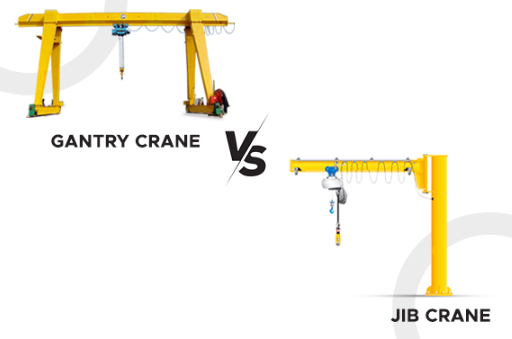
In the modern lifting and material handling industry, choosing the right crane system is crucial for improving productivity, safety, and efficiency. Among the most commonly used lifting solutions are the gantry crane and the jib crane. While both cranes serve the purpose of lifting and moving heavy loads, they differ greatly in structure, installation, and working range.
This article explains the main differences between gantry cranes and jib cranes, their typical applications, and how to select the most suitable option for your industrial or workshop needs.
1. Understanding the Gantry Crane
A gantry crane is a type of overhead lifting equipment supported by freestanding legs that move along rails or wheels on the ground. It consists of a bridge beam, legs, and a hoist that travels horizontally along the beam. Gantry cranes are widely used in outdoor and large-scale industrial applications because they do not rely on building structures for support.
Key Features of Gantry Cranes:
- Freestanding design with ground rails or rubber tires
- Can be full gantry, semi-gantry, or portable type
- Supports single or double girder configurations
- Handles light to extremely heavy loads (from a few tons to hundreds of tons)
- Suitable for indoor or outdoor operations
Common Applications:
- Shipyards and port terminals
- Construction sites and steel fabrication yards
- Warehouses and logistics hubs
- Outdoor assembly and heavy machinery repair areas
Advantages:
- High load capacity and large working range
- No dependence on building structure
- Flexible installation on open grounds
- Ideal for handling oversized materials
2. Understanding the Jib Crane
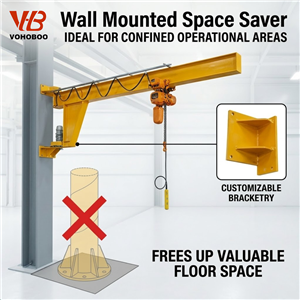
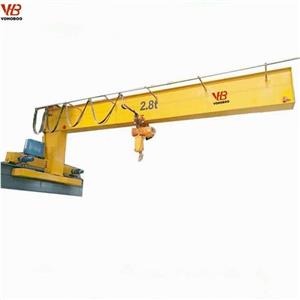
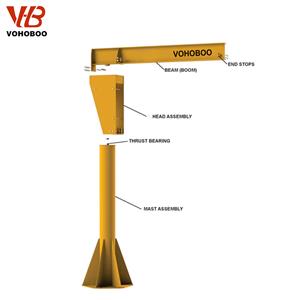
A jib crane is a more compact and localized lifting system designed for smaller work areas. It features a horizontal arm (jib or boom) that supports a hoist, which can move along the arm to lift and position materials. The jib is either mounted on a pillar (freestanding type) or attached to a wall or column (wall-mounted type).
Key Features of Jib Cranes:
- Rotating arm (typically 180° to 360° rotation)
- Compact design for workstation-level lifting
- Lower load capacity (typically from 0.25 to 5 tons)
- Manual or electric slewing available
- Often used with electric chain hoists
Common Applications:
- Workshops and assembly stations
- Maintenance and repair areas
- Production lines for repetitive lifting tasks
- Loading and unloading areas in small factories
Advantages:
- Simple structure and easy operation
- Space-saving and cost-effective
- Quick installation with minimal foundation requirements
- Perfect for precise, repetitive lifting tasks
3. Structural and Functional Differences
Although both gantry and jib cranes are lifting systems, their designs and working principles vary significantly.
Feature | Gantry Crane | Jib Crane
--- | --- | ---
Structure | Supported by freestanding legs on rails or wheels | Horizontal arm attached to a column or wall
Installation | Floor-mounted; no building support required | Mounted on floor pillar or wall bracket
Mobility | Can be mobile or rail-mounted | Fixed position (limited rotation)
Load Capacity | Medium to extremely heavy loads | Light to medium loads
Working Range | Large rectangular or circular area | Small circular lifting radius
Operation Area | Indoor or outdoor | Mainly indoor or localized
Maintenance | Ground-level access, easy maintenance | Minimal maintenance required
Cost | Higher due to larger structure and mobility | Lower installation and operating cost
Applications | Shipyards, factories, outdoor storage yards | Workshops, assembly lines, repair stations
4. Choosing Between Gantry Crane and Jib Crane
When selecting between a gantry crane and a jib crane, consider the following factors:
1. Workspace and Environment
- For large outdoor areas or construction sites, choose a gantry crane.
- For indoor workstations or limited spaces, a jib crane is ideal.
2. Load Capacity
- Gantry cranes handle heavier loads over long distances.
- Jib cranes are better for light, repetitive lifting near a fixed workstation.
3. Installation and Infrastructure
- Gantry cranes require more installation space and rail systems.
- Jib cranes can be installed on walls or floors with minimal foundation work.
4. Mobility and Flexibility
- Choose a gantry crane if mobility and wide coverage are priorities.
- Select a jib crane if you need precise and repetitive lifting at one location.
5. Cost and Maintenance
- Jib cranes are more cost-effective for small-scale applications.
- Gantry cranes provide greater lifting power and coverage but require higher investment.
6. Conclusion
Both gantry cranes and jib cranes are essential lifting solutions, but their optimal applications differ based on project requirements.
- Gantry cranes excel in heavy-duty, large-scale, and outdoor environments where flexibility and load capacity are key.
- Jib cranes, on the other hand, are best suited for localized, small-load lifting within workshops and production stations.
Understanding these differences allows businesses to select the right crane system—improving efficiency, safety, and operational productivity.