What Is a Low-Headroom Hoist? And When Should You Choose One?
What Is a Low-Headroom Hoist? And When Should You Choose One?
In many industrial lifting applications, available space is one of the most important factors affecting hoist and crane selection. Traditional hoists require a certain amount of headroom—the distance between the building ceiling (or supporting beam) and the hook in its highest position. However, in factories, warehouses, workshops, or production lines where the vertical lifting space is limited, a standard hoist may not provide sufficient lifting height.
This is where low-headroom hoists become an ideal solution. Designed specifically to maximize lifting height when overhead space is restricted, low-headroom hoists have become one of the most widely used configurations in modern material-handling systems.
1. What Is a Low-Headroom Hoist?
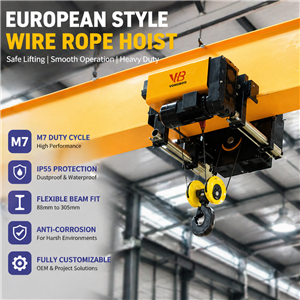
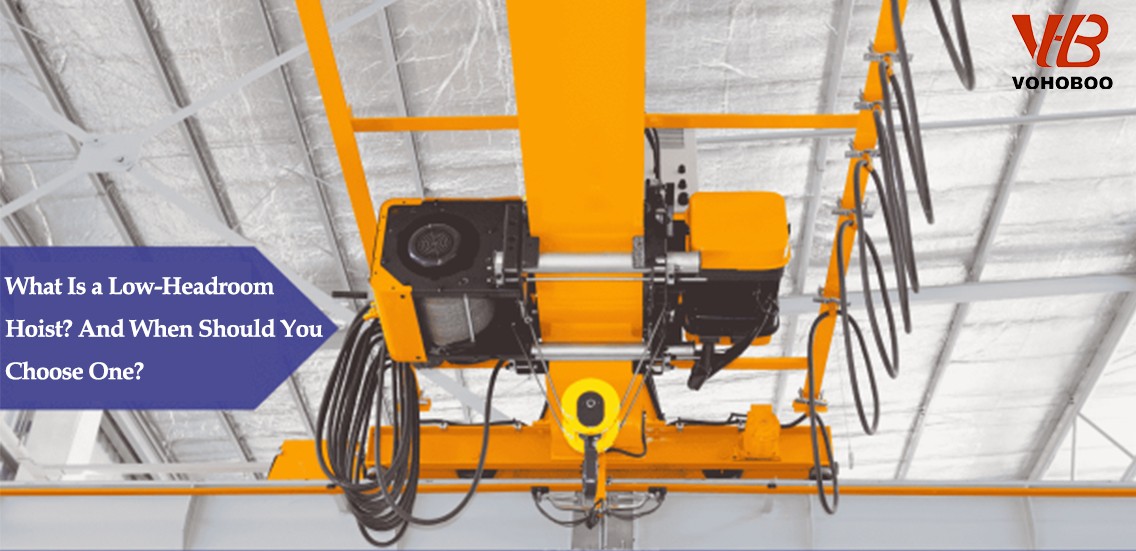
A low-headroom hoist is a hoist designed to reduce the distance between the hoist body and the hook, allowing the hook to reach a higher lifting position. Compared with a standard hoist, the overall lifting system occupies less vertical space, enabling maximum use of available headroom inside buildings.
2. How Does a Low-Headroom Hoist Work?
Low-headroom hoists modify the layout of the hoist and trolley to reduce the hook approach distance:
• Side-mounted or parallel-mounted motor
• Reduced dead space between hook and beam
• Compact trolley and hoist frame
3. Types of Low-Headroom Hoists
• Low-headroom electric chain hoist
• Low-headroom electric wire rope hoist
• Ultra-low headroom hoist
• Double-girder low-headroom hoist
4. Key Features and Advantages
• Maximizes lifting height
• Space-saving design
• Lower installation cost
• Enhanced safety
• High efficiency with frequency inverter options
5. When Should You Choose One?
• Limited vertical space
• Need for maximum lifting height
• Building modification not possible
• Compact production layouts
• Preference for modern European-style hoists
6. Applications
Low-headroom hoists are used in manufacturing plants, assembly lines, steel workshops, logistics centers, underground facilities, and areas with structural obstructions.
7. Comparison: Low-Headroom vs. Standard Hoist
Low-headroom hoists offer much lower headroom requirements and higher lifting height but have a slightly higher cost.
Conclusion
A low-headroom hoist is the ideal lifting solution for restricted spaces. Its compact design and advanced performance make it suitable for modern industrial environments.